

School Lunch, pizza, TONY'S Breakfast Pizza Sausage, frozen
Whole food · Fast Foods

Photo: Wikipedia
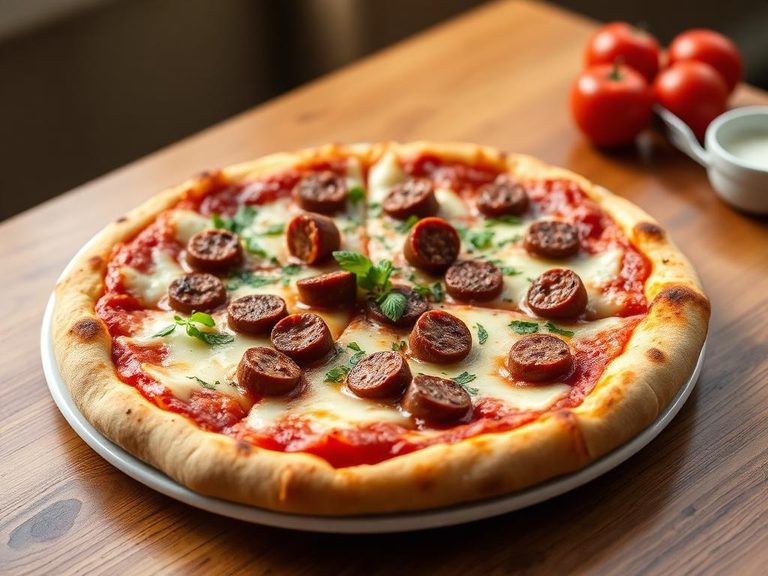
This is a pre-made, frozen breakfast pizza designed for school cafeterias, featuring a soft, bread-like crust topped with a simple tomato sauce, melted cheese, and crumbles of savory breakfast sausage. The texture is soft and chewy, typical of a reheated frozen pizza, with the sausage providing a salty, meaty contrast. Nutritionally, it's a calorie-dense item that delivers a notable amount of protein and fat from the sausage and cheese, alongside a significant carbohydrate load from the refined crust.
Calorie split: 17% protein · 45% carbs · 38% fat
↓ Full nutrition💚 Why it's loved
People love it for the comforting, familiar combination of melted cheese, savory sausage, and bready crust that feels like a treat rather than a standard cafeteria meal. It's a versatile format that can be eaten by hand, making it easy and fun for kids to consume.
⚠️ Watch-outs & how to enjoy it better
The primary downsides are its high sodium content from processed meats and cheese, and the use of refined carbohydrates which can lead to blood-sugar spikes. To counteract this, pair it with a side of fresh fruit or vegetables to add fiber and nutrients, and ensure it's part of a balanced day with other meals lower in sodium. Those with gluten or dairy allergies must avoid it entirely.
Key benefits
- Provides a convenient, hot meal option in institutional settings.
- Offers a balance of protein, carbohydrates, and fats for energy.
- The sausage and cheese contribute to a savory, satisfying flavor profile.
- Standardized portioning helps with meal planning and cost control.
- Familiar comfort food that encourages student participation in meal programs.
🍽️ Popular dishes




🌍 Where it's eaten
💡 Did you know?
Tony's is a major supplier of pizza to K-12 schools across the United States, making this specific pizza a ubiquitous part of the American school lunch experience for millions of students.
Full nutrition (USDA data · scales with serving)
| Water | 50.2 g |
| Energy | 240 kcal |
| Energy | 1004 kj |
| Protein | 10.4 g |
| Total lipid (fat) | 10.0 g |
| Ash | 2.4 g |
| Carbohydrate, by difference | 27.0 g |
| Fiber, total dietary | 2.0 g |
| Total Sugars | 5.9 g |
| Glucose | 1.1 g |
| Fructose | 1.3 g |
| Lactose | 0.75 g |
| Maltose | 2.7 g |
| Calcium, Ca | 176 mg |
| Iron, Fe | 2.1 mg |
| Magnesium, Mg | 28.0 mg |
| Phosphorus, P | 210 mg |
| Potassium, K | 229 mg |
| Sodium, Na | 600 mg |
| Zinc, Zn | 1.9 mg |
| Vitamin C, total ascorbic acid | 0.00 mg |
| Thiamin | 0.26 mg |
| Riboflavin | 0.28 mg |
| Niacin | 3.1 mg |
| Vitamin B-6 | 0.10 mg |
| Vitamin B-12 | 1.0 ug |
| Retinol | 90.0 ug |
| Carotene, beta | 56.0 ug |
| Vitamin A, IU | 395 iu |
Fat & fatty acid profile (per 100g)
| Fatty acids, total saturated | 3.5 g |
| Fatty acids, total monounsaturated | 2.5 g |
| Fatty acids, total polyunsaturated | 3.0 g |
| Fatty acids, total trans | 0.17 g |
| Cholesterol | 20.0 mg |
FAQ
Is this pizza considered a healthy breakfast option?
While it provides protein and energy, it is typically high in sodium, saturated fat, and refined carbohydrates. It's best viewed as an occasional convenience food rather than a daily nutritious breakfast.
How should I store and reheat leftover slices?
Keep frozen until ready to eat. For best results, bake from frozen in an oven or toaster oven at 375°F (190°C) for 12-15 minutes. Microwaving is faster but can result in a softer crust.
What are the main allergens in this product?
Common allergens in this type of product include wheat (gluten), milk (dairy), and soy. The sausage may also contain other allergens depending on the specific formulation.
Nutrient density (calculated · NRF9.3)
Nutrient Rich Foods index: beneficial nutrients (protein, fiber, vitamins, minerals) minus saturated fat, added sugar & sodium, per 100 kcal.
NRF9.3 index — Fulgoni, Keast & Drewnowski, 2009. Computed from USDA nutrients.
Weight-loss friendliness (composite index)
Energy density 2.40 kcal/g · 17% calories from protein · 2.0 g fiber · 5.9 g sugar per 100 g.
Composite of energy density (Rolls et al., 1999), protein & fiber satiety, minus sugar. A calculated heuristic — ranks satiety-per-calorie, not a clinical measure.
Dietary load (calculated from USDA values)
Potential renal acid load. Positive = acid-forming, negative = alkaline-forming.
Sodium-to-potassium ratio: 2.62 (lower is better — aim for ≤ 1)
Sodium:potassium per WHO potassium guidance. Computed from USDA nutrients.