

Ketchup, restaurant
Whole food · Vegetables and Vegetable Products
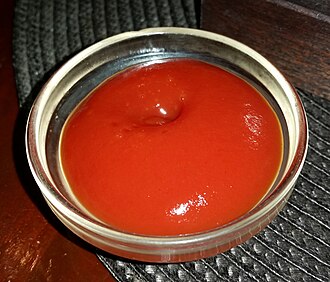
Photo: Wikipedia
Restaurant ketchup is a smooth, thick tomato condiment with a signature sweet-and-sour tang. Its vibrant red color and glossy texture make it instantly recognizable. Nutritionally, it's primarily a source of quick carbohydrates, with 26.8g per 100g, and is very low in protein and fat.
Calorie split: 4% protein · 92% carbs · 4% fat
↓ Full nutrition💚 Why it's loved
People love ketchup for its perfect balance of sweet, tangy, and savory flavors that complement a vast array of foods. Its cultural ubiquity as the default condiment for fries, burgers, and eggs makes it a nostalgic and versatile flavor enhancer.
⚠️ Watch-outs & how to enjoy it better
The high carbohydrate and added sugar content can cause blood-sugar spikes, making it less ideal for diabetics or those monitoring sugar intake. To counteract this, practice strict portion control (e.g., 1 tablespoon) and pair it with protein- and fiber-rich foods like grilled chicken or a baked potato to slow sugar absorption.
Key benefits
- Provides quick energy from carbohydrates
- Contains lycopene, an antioxidant from cooked tomatoes
- Low in fat and cholesterol
- Enhances palatability of other foods
🍽️ Popular dishes






🌍 Where it's eaten
💡 Did you know?
The name 'ketchup' likely derives from the Hokkien Chinese word 'kê-tsiap,' a fermented fish sauce that was a precursor to the modern tomato-based version.
Full nutrition (USDA data · scales with serving)
| Water | 68.5 g |
| Energy (Atwater General Factors) | 117 kcal |
| Energy (Atwater Specific Factors) | 103 kcal |
| Energy | 117 kcal |
| Energy | 488 kj |
| Nitrogen | 0.18 g |
| Protein | 1.1 g |
| Total lipid (fat) | 0.55 g |
| Ash | 3.0 g |
| Carbohydrate, by difference | 26.8 g |
| Sugars, Total | 21.8 g |
| Sucrose | 0.00 g |
| Glucose | 11.4 g |
| Fructose | 8.9 g |
| Lactose | 0.00 g |
| Maltose | 1.5 g |
| Galactose | 0.00 g |
| Calcium, Ca | 14.0 mg |
| Iron, Fe | 0.43 mg |
| Magnesium, Mg | 13.5 mg |
| Phosphorus, P | 25.0 mg |
| Potassium, K | 249 mg |
| Sodium, Na | 949 mg |
| Zinc, Zn | 0.16 mg |
| Copper, Cu | 0.07 mg |
| Manganese, Mn | 0.09 mg |
FAQ
Is ketchup healthy?
In small amounts, it's a low-fat condiment that provides some antioxidants like lycopene. However, it's high in added sugars and sodium, so it's best used sparingly as a flavor enhancer rather than a primary vegetable source.
Why is restaurant ketchup sometimes different?
Restaurant ketchup is often dispensed from a concentrate mixed with water or served in single-serve packets. The formulation may be adjusted for cost, consistency, and optimal flow from dispensers compared to bottled retail versions.
Does ketchup contain high-fructose corn syrup?
Many commercial and restaurant brands in the United States use high-fructose corn syrup as a primary sweetener. Some brands offer varieties sweetened with sugar or other alternatives.
Nutrient density (calculated · NRF9.3)
Nutrient Rich Foods index: beneficial nutrients (protein, fiber, vitamins, minerals) minus saturated fat, added sugar & sodium, per 100 kcal.
NRF9.3 index — Fulgoni, Keast & Drewnowski, 2009. Computed from USDA nutrients.
Weight-loss friendliness (composite index)
Energy density 1.17 kcal/g · 4% calories from protein · 0.0 g fiber · 0.0 g sugar per 100 g.
Composite of energy density (Rolls et al., 1999), protein & fiber satiety, minus sugar. A calculated heuristic — ranks satiety-per-calorie, not a clinical measure.
Dietary load (calculated from USDA values)
Potential renal acid load. Positive = acid-forming, negative = alkaline-forming.
Sodium-to-potassium ratio: 3.81 (lower is better — aim for ≤ 1)
Sodium:potassium per WHO potassium guidance. Computed from USDA nutrients.