

Cereals ready-to-eat, QUAKER, Natural Granola Apple Cranberry Almond
Whole food · Breakfast Cereals

Photo: Wikipedia
Quaker Natural Granola Apple Cranberry Almond is a crunchy, oven-baked blend of rolled oats, sliced almonds, and sweetened dried fruit. It offers a satisfying texture contrast between chewy fruit and toasted grains, with a balanced sweet-tart flavor profile. Nutritionally, it provides a notable 9.9g of fiber per 100g, supporting digestive health and sustained energy.
Calorie split: 8% protein · 69% carbs · 23% fat
↓ Full nutrition💚 Why it's loved
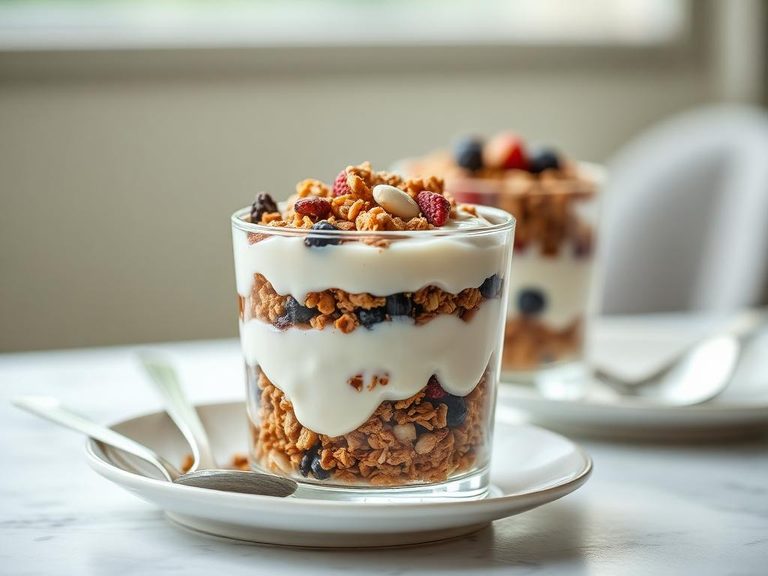
People love it for its satisfying crunch and the sweet-tart burst of cranberries paired with nutty almonds. It's a versatile staple that works as a quick breakfast, a topping for yogurt, or a standalone snack, fitting seamlessly into a modern, health-conscious lifestyle.
⚠️ Watch-outs & how to enjoy it better
The 27.43g of sugar per 100g can cause blood-sugar spikes, especially for those with insulin sensitivity. To mitigate this, pair it with a protein or fat source (like Greek yogurt or milk) and practice portion control by sticking to a 1/2 cup serving. Also, it contains common allergens like almonds and may be processed in facilities with other nuts or wheat.
Key benefits
- High in dietary fiber (9.9g per 100g) for digestive health.
- Good source of plant-based protein (9.21g per 100g) from oats and almonds.
- Contains healthy fats from almonds and oat bran.
- Provides quick energy from natural sugars and complex carbohydrates.
- Convenient, ready-to-eat format for busy mornings.
🍽️ Popular dishes
🌍 Where it's eaten
💡 Did you know?
The term 'granola' was coined in the 1860s by Dr. John Harvey Kellogg, who originally called his invention 'granula,' a baked oatmeal product meant to be a health food.
Full nutrition (USDA data · scales with serving)
| Water | 3.2 g |
| Energy | 418 kcal |
| Energy | 1749 kj |
| Protein | 9.2 g |
| Total lipid (fat) | 11.1 g |
| Ash | 1.8 g |
| Carbohydrate, by difference | 74.7 g |
| Fiber, total dietary | 9.9 g |
| Total Sugars | 27.4 g |
| Calcium, Ca | 98.0 mg |
| Iron, Fe | 2.5 mg |
| Magnesium, Mg | 106 mg |
| Phosphorus, P | 334 mg |
| Potassium, K | 444 mg |
| Sodium, Na | 47.0 mg |
| Zinc, Zn | 2.4 mg |
| Vitamin C, total ascorbic acid | 3.1 mg |
| Thiamin | 0.34 mg |
| Riboflavin | 0.26 mg |
| Niacin | 2.0 mg |
| Vitamin B-6 | 0.19 mg |
| Folate, total | 31.0 ug |
| Folate, food | 31.0 ug |
| Vitamin B-12 | 0.14 ug |
| Vitamin A, IU | 19.0 iu |
| Vitamin E (alpha-tocopherol) | 1.6 mg |
Fat & fatty acid profile (per 100g)
| Fatty acids, total saturated | 1.1 g |
| Fatty acids, total monounsaturated | 6.4 g |
| Fatty acids, total polyunsaturated | 3.0 g |
| Fatty acids, total trans | 0.11 g |
| Cholesterol | 2.0 mg |
FAQ
Is this granola gluten-free?
While oats are naturally gluten-free, Quaker granola may be processed in facilities that handle wheat. Always check the label for a gluten-free certification if you have celiac disease or severe sensitivity.
How does this compare to homemade granola?
Commercial granola like this often has more added sugar and preservatives than homemade versions, but it offers convenience and consistent texture. Homemade allows full control over ingredients and sweetness.
Can I eat this if I'm watching my sugar intake?
It contains 27.43g of sugar per 100g, which is relatively high. For sugar-conscious eaters, limit portions to 1/2 cup and pair with unsweetened yogurt or milk to balance the sweetness.
Nutrient density (calculated · NRF9.3)
Nutrient Rich Foods index: beneficial nutrients (protein, fiber, vitamins, minerals) minus saturated fat, added sugar & sodium, per 100 kcal.
NRF9.3 index — Fulgoni, Keast & Drewnowski, 2009. Computed from USDA nutrients.
Weight-loss friendliness (composite index)
Energy density 4.18 kcal/g · 9% calories from protein · 9.9 g fiber · 27.4 g sugar per 100 g.
Composite of energy density (Rolls et al., 1999), protein & fiber satiety, minus sugar. A calculated heuristic — ranks satiety-per-calorie, not a clinical measure.
Dietary load (calculated from USDA values)
Potential renal acid load. Positive = acid-forming, negative = alkaline-forming.
Sodium-to-potassium ratio: 0.11 (lower is better — aim for ≤ 1)
Sodium:potassium per WHO potassium guidance. Computed from USDA nutrients.