

Cereals ready-to-eat, QUAKER WHOLE HEARTS oat cereal
Whole food · Breakfast Cereals

Photo: Wikipedia
Quaker Whole Hearts is a classic, heart-shaped oat cereal known for its satisfying, crunchy texture and subtly sweet, toasted oat flavor. Each bite delivers a light, airy crispness that softens just enough in milk without becoming mushy. It's a fiber-rich start to the day, packing over 9 grams of dietary fiber per 100 grams.
Calorie split: 8% protein · 80% carbs · 13% fat
↓ Full nutrition💚 Why it's loved
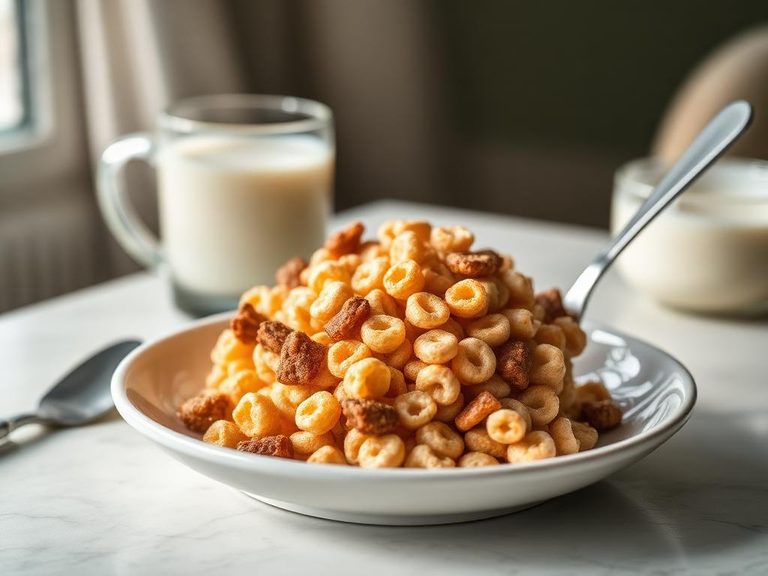
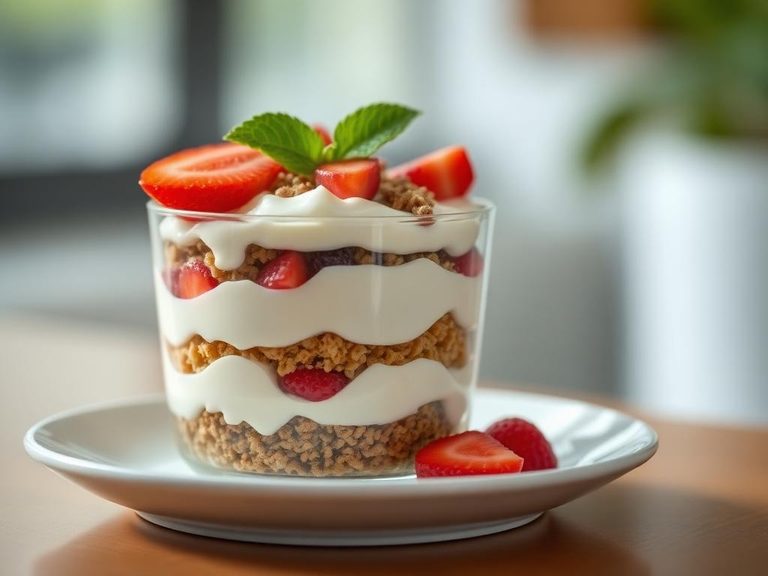
People adore it for its nostalgic, comforting taste and the perfect crunch that holds up in milk. It's a versatile staple, equally at home in a simple breakfast bowl, as a yogurt topping, or as a snack straight from the box.
⚠️ Watch-outs & how to enjoy it better
The relatively high sugar content (21.53g per 100g) can lead to a quick energy spike followed by a crash, making it less ideal for sustained satiety. To counteract this, pair it with a source of protein and healthy fat, like Greek yogurt, nuts, or seeds, and stick to a measured portion.
Key benefits
- Excellent source of dietary fiber (9.1g per 100g)
- Provides sustained energy from complex carbohydrates
- Good plant-based protein content (7.63g per 100g)
- Low in fat (5.61g per 100g)
- Fortified with essential vitamins and minerals
🍽️ Popular dishes

🌍 Where it's eaten
💡 Did you know?
The distinctive 'heart' shape was patented by the Quaker Oats Company in 1966 and was designed to be less prone to breaking in the box than flakes, preserving that signature crunch.
Full nutrition (USDA data · scales with serving)
| Water | 2.8 g |
| Energy | 376 kcal |
| Energy | 1575 kj |
| Protein | 7.6 g |
| Total lipid (fat) | 5.6 g |
| Ash | 3.9 g |
| Carbohydrate, by difference | 80.1 g |
| Fiber, total dietary | 9.1 g |
| Total Sugars | 21.5 g |
| Calcium, Ca | 0.00 mg |
| Iron, Fe | 32.1 mg |
| Magnesium, Mg | 77.0 mg |
| Phosphorus, P | 322 mg |
| Potassium, K | 568 mg |
| Sodium, Na | 554 mg |
| Zinc, Zn | 11.9 mg |
| Vitamin C, total ascorbic acid | 71.3 mg |
| Thiamin | 2.4 mg |
| Riboflavin | 1.3 mg |
| Niacin | 15.9 mg |
| Vitamin B-6 | 1.6 mg |
| Folate, total | 1427 ug |
| Vitamin B-12 | 4.8 ug |
| Vitamin A, IU | 3964 iu |
| Vitamin E (alpha-tocopherol) | 5.6 mg |
Fat & fatty acid profile (per 100g)
| Fatty acids, total saturated | 0.84 g |
| Fatty acids, total monounsaturated | 2.7 g |
| Fatty acids, total polyunsaturated | 1.5 g |
| Fatty acids, total trans | 0.00 g |
| Cholesterol | 0.00 mg |
FAQ
Is this cereal gluten-free?
While oats are naturally gluten-free, Quaker Whole Hearts is processed in facilities that also handle wheat. It is not certified gluten-free and may contain trace amounts, so it's not suitable for those with celiac disease.
How does the fiber content help?
The 9.1g of fiber per 100g, primarily from whole grain oats, supports digestive health and can help you feel full longer, aiding in appetite management.
Can I eat this on a low-sugar diet?
With 21.53g of sugar per 100g, it's on the sweeter side for a cereal. You can enjoy it in controlled portions, or mix it with a plain, high-fiber cereal to reduce overall sugar intake.
Nutrient density (calculated · NRF9.3)
Nutrient Rich Foods index: beneficial nutrients (protein, fiber, vitamins, minerals) minus saturated fat, added sugar & sodium, per 100 kcal.
NRF9.3 index — Fulgoni, Keast & Drewnowski, 2009. Computed from USDA nutrients.
Weight-loss friendliness (composite index)
Energy density 3.76 kcal/g · 8% calories from protein · 9.1 g fiber · 21.5 g sugar per 100 g.
Composite of energy density (Rolls et al., 1999), protein & fiber satiety, minus sugar. A calculated heuristic — ranks satiety-per-calorie, not a clinical measure.
Dietary load (calculated from USDA values)
Potential renal acid load. Positive = acid-forming, negative = alkaline-forming.
Sodium-to-potassium ratio: 0.98 (lower is better — aim for ≤ 1)
Sodium:potassium per WHO potassium guidance. Computed from USDA nutrients.