

Cereals ready-to-eat, QUAKER, Maple Brown Sugar LIFE Cereal
Whole food · Breakfast Cereals

Photo: Wikipedia
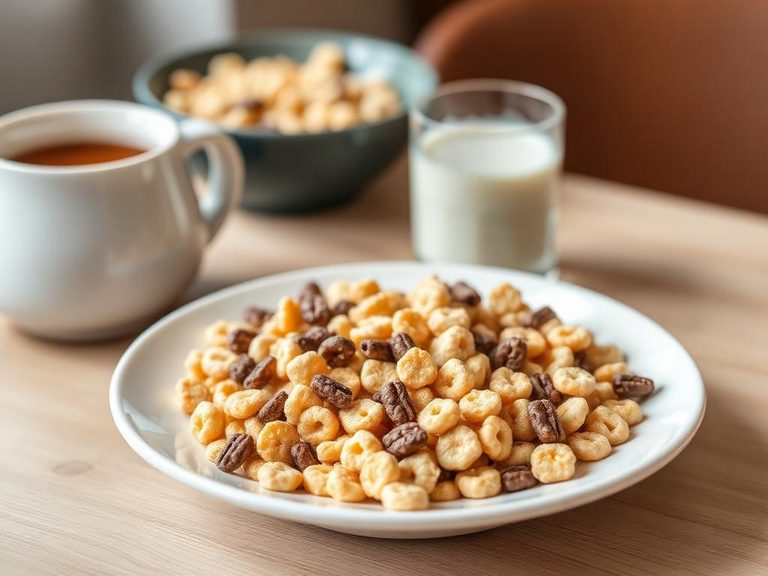
This is a classic American ready-to-eat oat cereal, featuring sweetened oat pieces with a distinct maple and brown sugar flavor. It offers a satisfying, crunchy texture that softens slightly in milk, providing a quick, energy-dense breakfast. Per 100g, it delivers a substantial 373 kcal, primarily from carbohydrates (78.86g), with a notable 24.9g of added sugar.
Calorie split: 9% protein · 81% carbs · 9% fat
↓ Full nutrition💚 Why it's loved
People adore its comforting, nostalgic maple-brown sugar flavor and reliable crunch, making it a beloved staple for both children and adults. Its versatility shines as a quick bowl with milk, a topping for yogurt, or a standalone dry snack.
⚠️ Watch-outs & how to enjoy it better
The high sugar content (24.9g/100g) can contribute to blood sugar spikes, making it a less ideal choice for those managing diabetes or seeking low-glycemic meals. To counteract this, pair it with a source of protein and fat (like Greek yogurt or nuts) to slow glucose absorption, and practice portion control by measuring a single serving.
Key benefits
- Provides quick energy from complex carbohydrates.
- Good source of dietary fiber (6.3g per 100g) for digestive health.
- Contains plant-based protein (9.17g per 100g).
- Fortified with essential vitamins and minerals (common in US cereals).
- Convenient, no-cook breakfast option.
🍽️ Popular dishes


🌍 Where it's eaten
💡 Did you know?
The LIFE cereal brand was famously marketed in the 1980s and 90s with the 'Mikey' commercials, featuring a picky younger brother who surprisingly liked the cereal.
Full nutrition (USDA data · scales with serving)
| Water | 4.3 g |
| Energy | 373 kcal |
| Energy | 1561 kj |
| Protein | 9.2 g |
| Total lipid (fat) | 4.1 g |
| Ash | 3.6 g |
| Carbohydrate, by difference | 78.9 g |
| Fiber, total dietary | 6.3 g |
| Total Sugars | 24.9 g |
| Calcium, Ca | 349 mg |
| Iron, Fe | 28.7 mg |
| Magnesium, Mg | 91.0 mg |
| Phosphorus, P | 389 mg |
| Potassium, K | 262 mg |
| Sodium, Na | 477 mg |
| Zinc, Zn | 13.5 mg |
| Vitamin C, total ascorbic acid | 0.00 mg |
| Thiamin | 1.3 mg |
| Riboflavin | 1.5 mg |
| Niacin | 17.9 mg |
| Vitamin B-6 | 1.8 mg |
| Folate, total | 1436 ug |
| Vitamin B-12 | 0.00 ug |
| Vitamin A, IU | 37.0 iu |
| Vitamin E (alpha-tocopherol) | 0.56 mg |
Fat & fatty acid profile (per 100g)
| Fatty acids, total saturated | 0.77 g |
| Fatty acids, total monounsaturated | 1.4 g |
| Fatty acids, total polyunsaturated | 1.3 g |
| Fatty acids, total trans | 0.00 g |
| Cholesterol | 0.00 mg |
FAQ
Is this cereal gluten-free?
No. LIFE Cereal is made from oats, which are often processed in facilities that handle wheat. It is not certified gluten-free and is generally not considered safe for those with celiac disease or severe gluten sensitivity.
How does the sugar content compare to other breakfast cereals?
At 24.9g of sugar per 100g, it is on the higher end for a ready-to-eat cereal, containing more sugar than many plain oat-based or whole-grain options but less than some highly sweetened children's cereals.
Can I use this cereal in baking?
Yes. Its crunchy texture makes it a good substitute for rolled oats or other cereals in recipes for cookies, bars, or as a topping for fruit crumbles and crisps, adding a sweet, maple note.
Nutrient density (calculated · NRF9.3)
Nutrient Rich Foods index: beneficial nutrients (protein, fiber, vitamins, minerals) minus saturated fat, added sugar & sodium, per 100 kcal.
NRF9.3 index — Fulgoni, Keast & Drewnowski, 2009. Computed from USDA nutrients.
Weight-loss friendliness (composite index)
Energy density 3.73 kcal/g · 10% calories from protein · 6.3 g fiber · 24.9 g sugar per 100 g.
Composite of energy density (Rolls et al., 1999), protein & fiber satiety, minus sugar. A calculated heuristic — ranks satiety-per-calorie, not a clinical measure.
Dietary load (calculated from USDA values)
Potential renal acid load. Positive = acid-forming, negative = alkaline-forming.
Sodium-to-potassium ratio: 1.82 (lower is better — aim for ≤ 1)
Sodium:potassium per WHO potassium guidance. Computed from USDA nutrients.