

Snow crab, legs only, frozen
Whole food · Finfish and Shellfish Products

Photo: Wikipedia
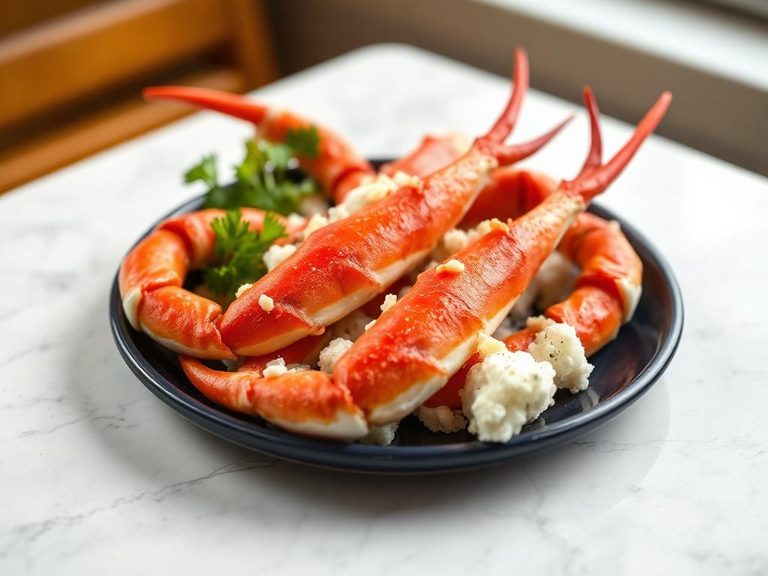
Snow crab legs are the sweet, delicate limbs of the Chionoecetes opilio crab, prized for their tender, flaky white meat that carries a subtle briny sweetness. Nutritionally, they are a powerhouse of lean protein with virtually no fat or carbs, making them an exceptionally clean and light seafood option. The meat is typically sold pre-cooked and frozen, ready to be simply reheated and enjoyed.
Calorie split: 90% protein · 6% carbs · 4% fat
↓ Full nutrition💚 Why it's loved
People love snow crab legs for their uniquely sweet, clean flavor and satisfying, melt-in-your-mouth texture that feels indulgent yet light. They are a centerpiece of festive seafood boils and elegant dinners, prized for the interactive, communal experience of cracking the shells to reveal the delicate meat inside.
⚠️ Watch-outs & how to enjoy it better
The primary downside is the potential for high sodium content, especially in pre-cooked or seasoned varieties, which can be a concern for those monitoring blood pressure. Snow crab is also a common shellfish allergen, and the process of cracking the legs can be messy and time-consuming; to mitigate sodium, look for unseasoned, plain frozen legs and rinse them briefly before serving, or pair with potassium-rich sides like steamed vegetables.
Key benefits
- Extremely high in lean protein (15.5g per 100g)
- Very low in calories (69 kcal per 100g)
- Virtually fat-free (0.3g per 100g)
- Good source of selenium and vitamin B12
- Naturally low in carbohydrates
🍽️ Popular dishes





🌍 Where it's eaten
💡 Did you know?
Snow crabs are known for their massive, cyclical population booms and busts, and a single female can release over 100,000 eggs at a time.
Full nutrition (USDA data · scales with serving)
| Water | 80.3 g |
| Energy (Atwater General Factors) | 69.2 kcal |
| Nitrogen | 2.5 g |
| Protein | 15.5 g |
| Total lipid (fat) | 0.29 g |
| Ash | 2.7 g |
| Carbohydrate, by difference | 1.1 g |
| Calcium, Ca | 97.8 mg |
| Iron, Fe | 0.28 mg |
| Magnesium, Mg | 58.4 mg |
| Phosphorus, P | 162 mg |
| Potassium, K | 193 mg |
| Sodium, Na | 729 mg |
| Zinc, Zn | 3.4 mg |
| Copper, Cu | 0.61 mg |
| Manganese, Mn | 0.02 mg |
| Selenium, Se | 60.0 ug |
| Vitamin B-12 | 2.2 ug |
FAQ
How do I cook frozen snow crab legs?
The easiest method is to steam them: place frozen legs in a steamer basket over boiling water, cover, and steam for 5-8 minutes until heated through. You can also boil them for 4-5 minutes or bake them at 375°F (190°C) for 10-12 minutes. Always avoid overcooking, as the meat can become tough.
Are snow crab legs already cooked?
Yes, virtually all commercially sold snow crab legs, especially frozen ones, are pre-cooked and flash-frozen at sea or shortly after harvest. You are essentially reheating them, not cooking them from raw.
What's the best way to crack and eat them?
Use a seafood cracker or the back of a heavy knife to gently crack the shell along its length. Pull the shell apart to reveal the meat, and use a small fork or pick to extract it from the joints. Dipping the meat in melted butter or lemon juice is a classic way to enhance the flavor.
Nutrient density (calculated · NRF9.3)
Nutrient Rich Foods index: beneficial nutrients (protein, fiber, vitamins, minerals) minus saturated fat, added sugar & sodium, per 100 kcal.
NRF9.3 index — Fulgoni, Keast & Drewnowski, 2009. Computed from USDA nutrients.
Weight-loss friendliness (composite index)
Energy density 0.69 kcal/g · 90% calories from protein · 0.0 g fiber · 0.0 g sugar per 100 g.
Composite of energy density (Rolls et al., 1999), protein & fiber satiety, minus sugar. A calculated heuristic — ranks satiety-per-calorie, not a clinical measure.
Dietary load (calculated from USDA values)
Potential renal acid load. Positive = acid-forming, negative = alkaline-forming.
Sodium-to-potassium ratio: 3.78 (lower is better — aim for ≤ 1)
Sodium:potassium per WHO potassium guidance. Computed from USDA nutrients.