

Archway Home Style Cookies, Molasses
Whole food · Baked Products
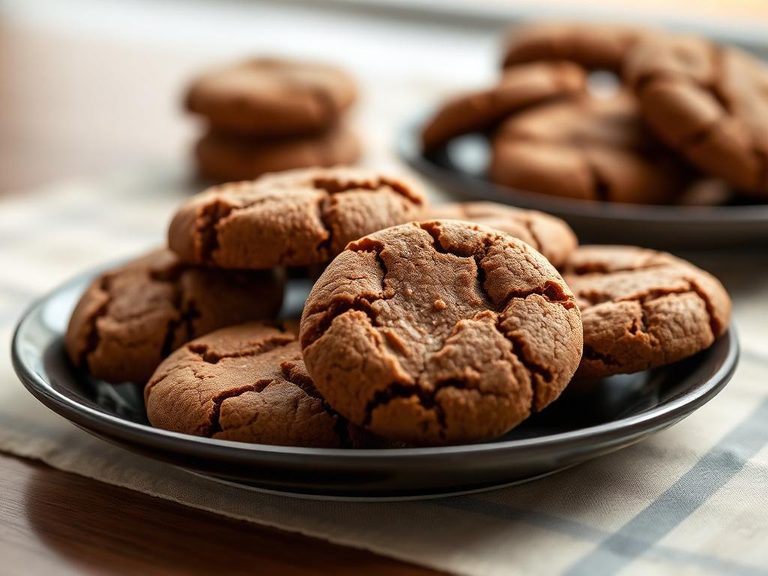
Archway Home Style Molasses Cookies are thick, chewy rounds with a deep, warm sweetness from robust molasses and a hint of spice. Their texture is delightfully soft with slightly crisp edges, offering a nostalgic, comforting bite. Nutritionally, they are a dense source of carbohydrates and sugars, providing quick energy.
Calorie split: 4% protein · 69% carbs · 27% fat
↓ Full nutrition💚 Why it's loved
People love these cookies for their distinct, rich molasses flavor that balances sweetness with a slight, pleasant bitterness, evoking memories of home baking. Their chewy texture and versatility make them a perfect companion to milk, coffee, or as a standalone snack.
⚠️ Watch-outs & how to enjoy it better
The high sugar content (36.35g per 100g) can lead to rapid blood-sugar spikes and may not be suitable for those managing diabetes. They also contain common allergens like wheat and may be processed in facilities with nuts. To counteract, pair a single cookie with a source of protein or healthy fat (like a handful of nuts or a glass of milk) to slow sugar absorption, and practice strict portion control.
Key benefits
- Provides a quick source of energy from carbohydrates
- Contains small amounts of iron and B vitamins from molasses
- Offers a comforting, nostalgic treat for emotional well-being
- Can be easily portioned for a controlled indulgence
🍽️ Popular dishes


🌍 Where it's eaten
💡 Did you know?
Molasses, the key ingredient, is a byproduct of refining sugarcane or sugar beets into sugar, and its use in cookies became especially popular in the United States during the 18th and 19th centuries when it was a cheaper, more accessible sweetener than refined sugar.
Full nutrition (USDA data · scales with serving)
| Water | 11.4 g |
| Energy | 403 kcal |
| Energy | 1687 kj |
| Protein | 4.3 g |
| Total lipid (fat) | 12.1 g |
| Ash | 2.9 g |
| Carbohydrate, by difference | 69.4 g |
| Fiber, total dietary | 1.2 g |
| Total Sugars | 36.4 g |
| Calcium, Ca | 29.0 mg |
| Iron, Fe | 4.7 mg |
| Potassium, K | 117 mg |
| Sodium, Na | 577 mg |
| Vitamin C, total ascorbic acid | 0.00 mg |
| Thiamin | 0.30 mg |
| Riboflavin | 0.23 mg |
| Niacin | 2.7 mg |
| Folate, total | 69.0 ug |
| Folate, food | 69.0 ug |
| Vitamin A, IU | 17.0 iu |
Fat & fatty acid profile (per 100g)
| Fatty acids, total saturated | 2.8 g |
| Fatty acids, total monounsaturated | 4.9 g |
| Fatty acids, total polyunsaturated | 1.1 g |
| Fatty acids, total trans | 3.3 g |
| Cholesterol | 25.0 mg |
FAQ
What gives these cookies their distinctive dark color and flavor?
The dark color and rich, slightly bitter-sweet flavor come from molasses, which is a thick syrup produced during the sugar refining process.
Are Archway Molasses Cookies considered a healthy snack?
They are primarily a treat food. While they provide energy, their high sugar and calorie content means they are best enjoyed occasionally and in moderation as part of a balanced diet.
How should I store these cookies to keep them fresh?
Store them in an airtight container at room temperature. To maintain their chewy texture, you can add a slice of bread to the container, which will release moisture and keep the cookies soft.
Nutrient density (calculated · NRF9.3)
Nutrient Rich Foods index: beneficial nutrients (protein, fiber, vitamins, minerals) minus saturated fat, added sugar & sodium, per 100 kcal.
NRF9.3 index — Fulgoni, Keast & Drewnowski, 2009. Computed from USDA nutrients.
Weight-loss friendliness (composite index)
Energy density 4.03 kcal/g · 4% calories from protein · 1.2 g fiber · 36.4 g sugar per 100 g.
Composite of energy density (Rolls et al., 1999), protein & fiber satiety, minus sugar. A calculated heuristic — ranks satiety-per-calorie, not a clinical measure.
Dietary load (calculated from USDA values)
Sodium-to-potassium ratio: 4.93 (lower is better — aim for ≤ 1)
Sodium:potassium per WHO potassium guidance. Computed from USDA nutrients.